

Minimal PID controller in Python.
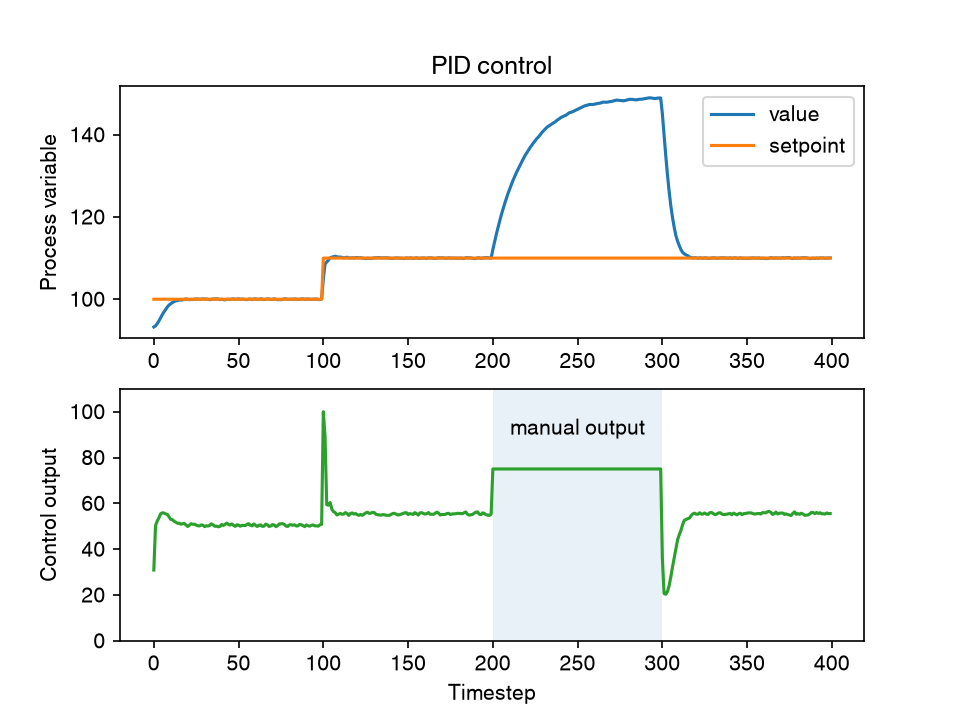
Install from PyPI via:
pip install tinypid
The development version can be installed directly from this repository:
pip install git+https://github.com/asteppke/tinypid.git
or clone it and install in editable mode for local development:
git clone https://github.com/asteppke/tinypid.git
cd tinypid
pip install -e .
or, using uv (used in CI):
git clone https://github.com/asteppke/tinypid.git
cd tinypid
uv sync --extra dev
import tinypid

controller = tinypid.PID(k_p=1.0, k_i=0.1, k_d=0.0, setpoint=0.0)

value = 10
output = controller(value)PIDCorecontains the shared PID calculation and state, without output limiting.LimitedPIDadds absolute output limits and saturation anti-windup.PIDbuilds onLimitedPIDand includes all optional feature mixins. Their behaviors remain disabled unless enabled with their corresponding options.
- Output limiting
- Anti-windup mechanism
- Lowpass filtering of derivative component
- Bumpless transfer between manual and automatic control
- Gain scheduling
- Feed forward component
- Output rate limiting
- Output dead-band
- Output dithering
- Combining multiple features
upper_limit = 10
lower_limit = -10
controller = tinypid.PID(upper_limit=upper_limit, lower_limit=lower_limit)

value = 10000

for i in range(100):
    output = controller(value)
    value += output
assert lower_limit <= output <= upper_limitPrevents the integral term from accumulating further while the output is at the upper or lower limit. Enabled by default, can be disabled via anti_windup=False.
controller = tinypid.PID(k_p=10.0, k_i=1.0, setpoint=100.0, upper_limit=5.0, lower_limit=-5.0)

for _ in range(5):
    output = controller(0.0)  # large error keeps the output saturated at upper_limit

assert controller.integral == 0.0 # anti-windup (default) kept the integral from growingSmooths the derivative term to reduce sensitivity to noisy measurements. derivative_lowpass ranges from 0 (heavy filtering) to 1 (no filtering).
controller = tinypid.PID(k_d=1.0, setpoint=10.0, derivative_lowpass=0.2)

for value in [8.0, 9.0, 7.0, 9.5]:
output = controller(value)Passing manual_output back-calculates the integral so that control resumes smoothly when switching back to automatic mode.
controller = tinypid.PID(k_p=1.0, k_i=0.5, setpoint=10.0)

output = controller(8.0, manual_output=5.0)  # operator takes manual control
output = controller(8.0) # back to automatic, output continues from the manual valueSwitches between sets of gains depending on which range the setpoint falls into.
gains = [
    tinypid.Gain(setpoint_scope=(0, 50), k_p=1.0, k_i=0.1, k_d=0.0),
    tinypid.Gain(setpoint_scope=(50, 100), k_p=2.0, k_i=0.2, k_d=0.0),
]
controller = tinypid.PIDGainScheduler(gains=gains, setpoint=80.0)

output = controller(0.0) # uses the k_p=2.0, k_i=0.2 gains since setpoint falls in (50, 100)Adds an external feedforward signal (e.g. a model output or setpoint velocity) to the controller output, scaled by k_ff.
controller = tinypid.FeedforwardPID(k_p=1.0, k_i=0.1, k_ff=0.5, setpoint=10.0)
output = controller(process_variable=8.0, feedforward=4.0)Limits how fast the output may change per step (slew-rate limiting), independent of the absolute output limits.
controller = tinypid.RateLimitedPID(k_p=10.0, setpoint=10.0, max_output_rate=2.0)

controller(10.0)  # error = 0, establishes the previous output
output = controller(0.0) # raw output would be 100, but is limited to a change of 2.0Holds the previous output for small changes, e.g. to reduce actuator chatter or motor noise near steady state.
controller = tinypid.DeadbandPID(k_p=1.0, setpoint=10.0, output_deadband=1.0)

controller(10.0)  # error = 0, output = 0
output = controller(9.5) # raw output = 0.5, within the deadband -> held at 0.0Adds small pseudo-random noise to the output to improve its effective resolution on quantized actuators (e.g. a stepper motor or digital output), by randomizing the rounding error instead of letting it accumulate systematically.
controller = tinypid.DitheredPID(k_p=1.0, setpoint=10.0, output_dither=0.2, dither_seed=1)
output = controller(8.0) # undithered output is 2.0, dithered output varies within +/- 0.1PID and PIDGainScheduler include all the optional feature mixins, so their
features can be combined through constructor options without creating another
subclass:
controller = tinypid.PID(
    k_p=10.0,
    setpoint=10.0,
    upper_limit=100.0,
    max_output_rate=2.0,
    output_deadband=0.5,
    k_ff=0.1,
    output_dither=0.2,
    dither_seed=1,
)

controller(10.0)  # error = 0, establishes the previous output
output = controller(0.0, feedforward=1.0)  # output passes through limiting, dead-band, and dither
For a custom controller with a different feature combination, compose mixins
with LimitedPID (or PIDCore when output limiting is not needed) rather than
with PID, which already includes those mixins.
MIT, see LICENSE.
Pushing a tag matching vX.Y.Z (e.g. v0.7.1) triggers the
publish workflow, which builds the package
with uv build and publishes it to PyPI via Trusted Publishing. Make sure the
version in pyproject.toml matches the tag before pushing it.
See examples/Examples.ipynb for a worked simulation that produces the plot above.
- Beyond gain scheduling also schedule, limits, and anti-windup