A coding-agent terminal for the GLM engine you already pay for — streaming TUI, tool calls, checkpoints, quota insight — driving your installed ZCode runtime from the shell.




English · 中文
Requires Node ≥ 22.15 · a ZCode runtime install · a GLM Coding Plan
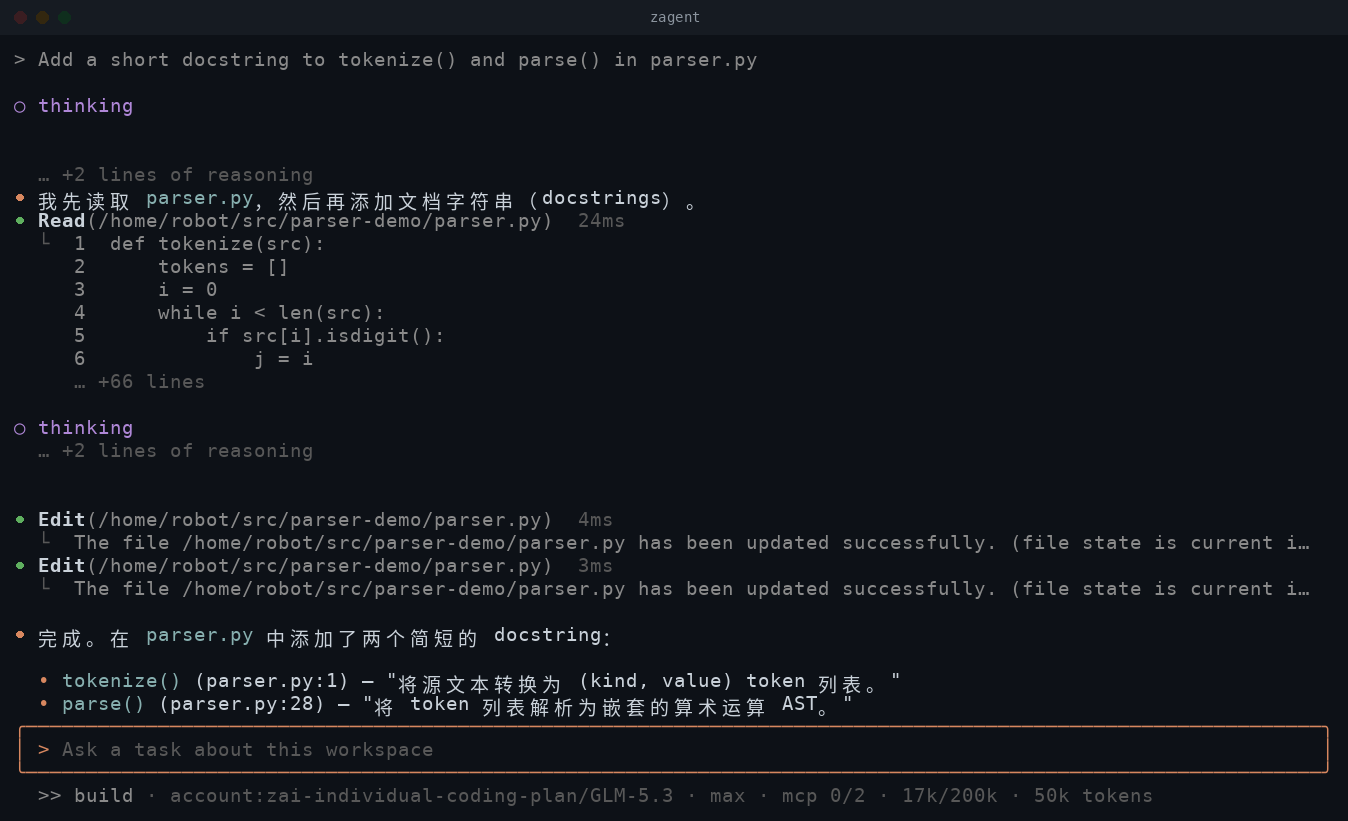
A real session: the model reads parser.py, asks before it edits, and summarizes what changed with file:line references. This is a captured PTY session, not a mockup.
npx zagent -p "Add a --json flag to cli.py and update the tests"Unofficial. Not affiliated with or endorsed by Z.ai. zagent ships no Z.ai binaries — it drives the ZCode runtime you already installed, on your own account.
Why · Quick start · Commands · How it works · Compatibility · FAQ · Changelog
The ZCode runtime Z.ai ships in its desktop app already has a terminal mode. Try it on a stock install and it dies:
$ zcode tui
Error: Cannot find package '@zcode/tui'
The runtime imports that module. Z.ai does not publish it. So the terminal path is a dead import on every machine that has ZCode installed.
zagent is that missing module — a native TUI written against the runtime's own 28-member host
contract — plus the CLI around it. It supplies @zcode/tui through a Node ESM resolve hook, so
the runtime is read in place: nothing copied, nothing patched, nothing written into its
install root. You get the same GLM engine the desktop app runs, driven from the terminal you
already work in, on the Coding Plan you already pay for.
$ zagent
⏺ zagent 0.0.237 · runtime desktop-bundle 3.12.1 · account:zai/GLM-5.3
  ~/src/myproject
  ? shortcuts · / commands · @ files

╭──────────────────────────────────────────────────────────────╮
│ > refactor the parser to use a lookup table                  │
╰──────────────────────────────────────────────────────────────╯
  ⠋ working 4.2s · esc interrupt

I'll replace the if/elif chain with a dispatch table…

⏺ Read(src/parser.py)
  ⎿ 214 lines

⏺ Edit(src/parser.py)
  ⎿ +18 −31

    parser = {
      "INTEGER": parse_int,
      "STRING":  parse_string,
    }

plan max · 5-hour window: 23% used · resets 14:25
>> build · account:zai/GLM-5.3 · max · mcp 0/2| A real TUI | Token-by-token streaming with live reasoning preview, rendered markdown (fenced code with language labels, tables), one-line tool calls with results, permission prompts, model/effort pickers, 25+ slash commands, @-file completion, session folds. Wide-character correct (CJK, emoji); every rendered string sanitised against ANSI/bidi injection. |
| Headless too | zagent -p "…" --json for scripts, CI and pipelines. Real exit codes: a failed turn fails, a typo'd command fails. |
| Your plan, your machine | Runs on your own GLM Coding Plan and your own installed runtime. Nothing bundled, nothing phoned home. |
| The rest of the product | Quota, sessions, per-turn diffs, memory, scheduled prompts, and plugins — all from the CLI. |
| Cross-platform | Runtime discovery on Linux, macOS and Windows. |
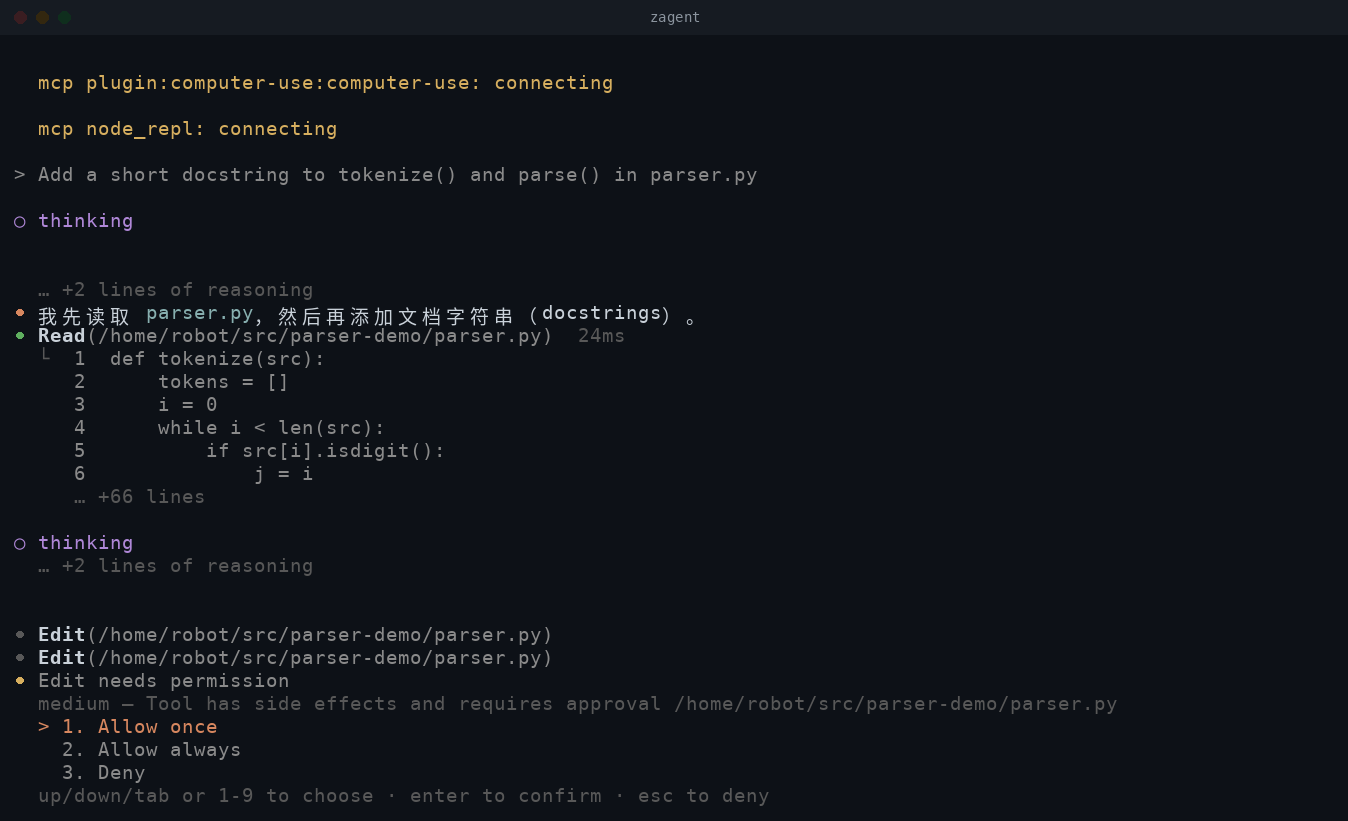
Mutating tools ask first — Allow once, Allow always, or Deny, straight from the TUI:
- Undo any turn —
zagent rewind latestrestores the files a turn changed, from real checkpoints;rewind changesshows what a turn did before you decide. - Know what you're spending —
zagent quotashows the 5-hour window, plan level and reset time right in the TUI status line;quota resetmanages your reset cards (confirm-gated). - Scheduled agents — local
cronand server-sideautomationschedules that run prompts when you're not there. - Usage analytics —
zagent usage statsgives per-model/per-tool breakdowns, cache-hit rate and streaks from the same data the desktop app shows. - Your CLIs, imported —
zagent importbrings Claude Code instructions, commands and skills over.
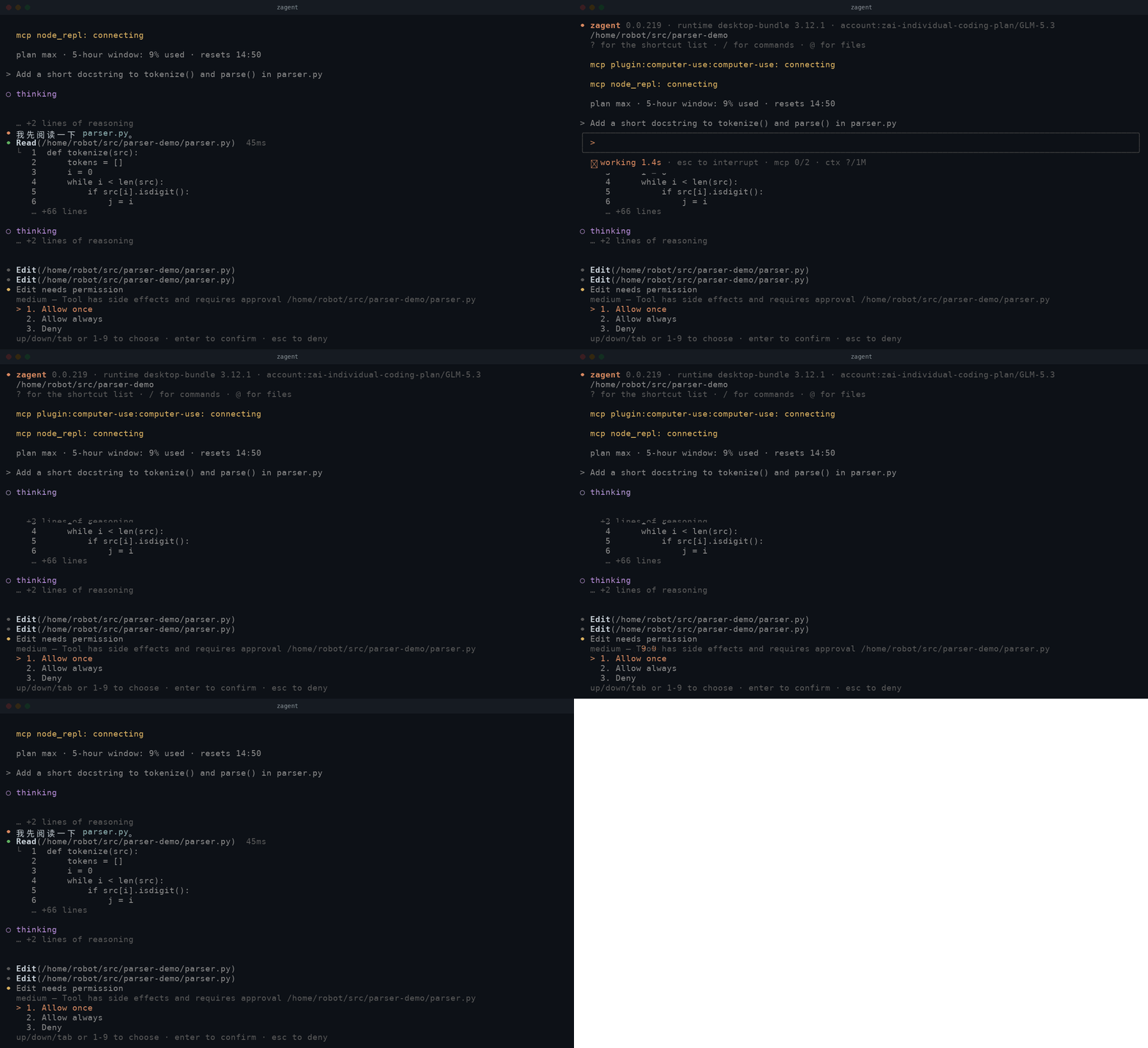
A turn as it happens — prompt, thinking fold, streaming reply, tool calls:
npm install -g zagent          # or run ad-hoc: npx zagent
zagent doctor                  # checks your runtime + Coding Plan setup
zagent -p "Explain this repo"  # headless one-shot
zagent                         # interactive TUI
zagent update # stay on the latest release- Node.js ≥ 22.15 (Node 23 needs ≥ 23.5). Check
node --versionbefore installing — on macOS a stale/usr/local/bin/node(an old Intel-Homebrew install) can shadow the current one in PATH. To install or upgrade Node on macOS:brew install node(ornvm install --lts). npm install -gpermission errors (EACCES)? Your npm global prefix is root-owned — common with/usr/localon Intel Macs. Prefer a user-level toolchain (nvm, ornpm config set prefix ~/.npm-globaland add~/.npm-global/binto PATH) oversudo. After install,zagent/zamust be on PATH: they live in$(npm prefix -g)/bin.- A GLM Coding Plan and your own installed ZCode runtime — the ZCode desktop app, or the
third-party
zcode-app-cli. Either works for both headless and interactive use: zagent brings its own TUI, so no third-party package is required.
Verified against ZCode desktop 3.11.2 and 3.12.1:
| Capability | ZCode 3.11.x | ZCode 3.12.x |
|---|---|---|
Headless zagent -p |
✓ | ✓ |
| Interactive TUI | not verified | ✓ — needs a 3.12.1-era sign-in (a 3.11.2-era credential store is not migrated by the kernel; sign in once from the desktop app) |
commit-msg, automation, usage stats, offpeak tools |
— | ✓ |
zagent runs on your GLM Coding Plan subscription — not a metered pay-per-token API key.
Provide your Coding Plan credential once and zagent writes a local, 0600 config:
export ZAI_API_KEY=<your GLM Coding Plan credential>   # or reuse ~/.config/ccz/.api_key
zagent doctor --fix                                    # writes ~/.zcode/cli/config.json
zagent doctor tells you exactly what's missing. Your credential stays on your machine and is
sent only to your own provider endpoint.
| Command | What it does |
|---|---|
zagent -p "…" [--json] [options] |
Headless one-shot (retry-safe; zagent -p --help lists options) |
zagent |
Interactive TUI |
zagent onboard |
First-run: checks + live smoke + guidance |
zagent doctor [--fix] |
Runtime / Coding-Plan / config diagnosis |
zagent update [--check] |
Update zagent itself from npm |
zagent models [query] |
Search the model catalog; models test <provider/model> checks a connection |
zagent login [--no-browser] |
Sign in to your account |
zagent logout |
Sign out of the current account |
zagent quota [status|usage [--days 1..30]|balance|preview|reset] [--json] |
Coding-Plan usage |
zagent sessions [--json] |
Your task store, in the terminal |
zagent diff [sessionId] |
Per-turn / per-file changes |
zagent rewind [list|latest|<checkpointId>|changes|preview [<checkpointId>]] [--message id] [--session id] [--json] |
Inspect or restore workspace checkpoints (undo a turn's file edits) |
zagent memory show|index|append |
Runtime-compatible memory |
zagent commit-msg [--model provider/model|model] [--effort <level>] [--json] |
Generate a commit message for staged (or unstaged) changes (ZCode 3.12.x+) |
zagent task list [--all] [--json]|archive|unarchive|pin|unpin|rename|delete |
Inspect or modify runtime task records |
zagent permissions [list|revoke <pattern|all>|--reset] [--json] |
View or revoke remembered always-allow/deny grants |
zagent cron add [--json]|list [--json]|remove [--json]|tick |
Scheduled prompts (local crontab) |
zagent automation list|create|update|delete|check-binding |
Server-side scheduled prompts (ZCode 3.12.x+) |
zagent bots [list|show <id>|status] [--json] |
Chat bots configured in the desktop (read-only) |
zagent offpeak [--refresh] [--json]|offpeak tools [on|off] [--json] |
Campaign time-window check (billing not verified); tools toggles the 3.12.x off-peak tool port |
zagent plugins [list] [name] [--json] |
Manage local plugins; plugins install <name> installs one |
zagent hooks list [--json] |
List configured ZCode hook events (does not run them) |
zagent inspect [--storage] [--json] |
Dump runtime/config/skills; --storage = ~/.zcode category sizes (read-only) |
$using-zagent |
Bundled skill: what zagent is, how to tell it from the GUI, how to drive it |
zagent import [--dry-run|--apply] [--force] [--json] |
Import Claude Code instructions, commands, and skills |
zagent goal [list|show|set <text>|pause|resume|clear] [--session id] [--json] |
Show or control the current session objective |
zagent subagents [--session id] [--json] |
List running and ended child session ids |
zagent usage [--session id] [--json] |
Session token totals + context baseline breakdown |
zagent usage stats [--range all|7d|30d] [--json] |
App-usage dashboard: totals, cache hit rate, streaks, per-model/tool breakdown (ZCode 3.12.x+) |
zagent remote [status|connect \[--live]] [--json] |
This-host relay device id / last ack (D1/D2; no second-device control) |
zagent mcp |
Serve zagent as MCP tools over stdio, so other agents can call it |
za is a short alias for zagent.
zagent mcp speaks the Model Context Protocol on stdin/stdout, so any
MCP-capable agent can call zagent as a tool. Tools: zagent_turn (one headless
prompt — the -p equivalent — with optional model/effort/mode/cwd),
zagent_quota, zagent_models, zagent_doctor. Credentials stay in the local
config the server reads; they never cross the MCP boundary, and the transport
is stdio only — no network listener. zagent_turn runs with -p semantics —
tool permissions are auto-approved — so only register it for clients you trust;
pass mode: "plan" for a read-only turn.
Claude Code (.mcp.json):
{ "mcpServers": { "zagent": { "command": "zagent", "args": ["mcp"] } } }opencode (opencode.json):
{ "mcp": { "zagent": { "type": "local", "command": ["zagent", "mcp"], "enabled": true } } }Context compaction runs inside the interactive TUI as /compact — live sessions are
process-local, so there is no standalone zagent compact command.
zagent is a thin, protocol-first client. It discovers a compatible runtime — ZCODE_RUNTIME
first, then the ZCode desktop bundle per OS, then zcode-app-cli — and drives it over its native
protocol.
The interactive TUI is zagent's own (packages/tui). The ZCode runtime imports a @zcode/tui
module that z.ai does not ship, so on a stock desktop install zcode tui fails with
Cannot find package '@zcode/tui'; zagent supplies that module through a Node ESM resolve hook.
The runtime is read in place — nothing is copied, patched, or written into its install root.
Set ZAGENT_TUI=runtime to hand off to a TUI the runtime vendors instead.
It ships no runtime binaries and uses your Coding Plan. Running it can make real requests and execute tools with your permissions, so use trusted workspaces and review changes.
Not auto-discovered? Point at it explicitly:
export ZCODE_RUNTIME=/absolute/path/to/runtime-entry.cjsRuntime discovery covers Linux, macOS, and Windows (unit-tested across all three). Linux is fully validated; macOS and Windows are supported at the code level and being hardened against every GUI install layout.
zagent quota reads the live Z.ai Coding Plan pools; zagent quota usage --days 7 --json
reads account-wide calls and reported tokens (1–30 Singapore calendar days, including
the partial current day). Reported tokens are not billed credits, and shared-account
usage cannot distinguish ccz from zagent. Missing quota amounts remain unknown;
percentages can be rounded. ZAI_API_KEY explicitly overrides the queried account;
otherwise the selected CLI provider key is used, then the kernel-provisioned
key from zagent login (v2/provider_config.json), with the ccz key file as a
fallback only when CLI configuration is absent. balance / preview query separate desktop
billing records; an empty balance is not proof of zero Coding Plan usage. reset
reads reset-card availability without consuming a card. Under --json, failure
objects carry a class field (auth, limit, network, or null when
unclassified) so scripts can branch without parsing prose.
Task, memory, diff, and quota output can contain private workspace, prompt, or account data. Redact before sharing logs, and never commit credentials or config files.
- Is this an official Z.ai product? No. zagent is unofficial, not affiliated with or endorsed by Z.ai, and ships none of its binaries — see the NOTICE.
- Does it cost anything beyond my plan? No. It runs on the GLM Coding Plan you already pay for, not a metered API key.
- Where do my credentials live? In a local
0600config (~/.zcode/cli/config.json). They are sent only to your own provider endpoint — there is no zagent telemetry. - Which ZCode versions work? Headless works on 3.11.x and 3.12.x; the TUI is verified on 3.12.1 and needs a 3.12.1-era sign-in — see Compatibility.
Every release is documented: CHANGELOG.md · Releases.
Issues and PRs are welcome — see CONTRIBUTING and SECURITY. Questions and ideas go in Discussions.
MIT — for non-commercial, personal interoperability and research. You are responsible for complying with Z.ai's terms for your own account. See NOTICE for the interoperability disclaimer.