
Lossless speculative decoding for HuggingFace causal language models, with a static-cache CUDA-graph fast path.





FlashSpec wraps an existing HuggingFace causal LM and a smaller drafter that shares its tokenizer: the drafter proposes tokens, your model checks them in one forward pass, and the output is your model's own: the same distribution when sampling, and the same tokens in greedy mode up to fp16 ties (correctness). On one Tesla T4, with Qwen/Qwen2.5-1.5B-Instruct verified by Qwen/Qwen2.5-0.5B-Instruct at batch 1, with the default settings, it was faster than HuggingFace generate compiled the same way in every measured cell, by at least 1.5x on HumanEval and by less on MT-Bench (results). That is the whole measured scope (one model pair, one GPU, batch 1), and FlashSpec is a single-device library with a small HTTP server, not a serving stack.
Use it when:
- you run a HuggingFace causal LM on a CUDA GPU, one request at a time (batch 1);
- you have a smaller drafter with the same tokenizer, or your outputs copy from the prompt (code edits, quoting), where the built-in prompt-lookup drafter needs no second model;
- you need your model's exact output, not an approximation of it.
Not yet:
- CPU. Both recorded CPU end-to-end runs were slower than plain decoding (history).
- Batch > 1. Larger batches use a generic loop that reads the device several times per step and has not been measured.
- First-call latency. On CUDA the first
generatecompiles and captures CUDA graphs, which can take minutes.compile=Falseskips that, but in the 0.3.0 run the eager path, while faster than plain HuggingFacegeneratein all 4 cells, was slower than compiled HuggingFace in all 4. - Other GPUs and model pairs. They have not been measured.
pip install flashspec| extra | adds | when you want it |
|---|---|---|
flashspec[gpu] |
Triton (Linux only) | The compiled path needs Triton; Linux CUDA builds of PyTorch already ship it. Also enables the experimental Triton kernels. |
flashspec[serve] |
FastAPI, uvicorn, httpx, accelerate | The OpenAI-compatible server (it loads checkpoints with device_map, which needs accelerate). |
flashspec[asm] |
flashspec-asm-kernel (Linux x86-64) |
An experimental CPU residual kernel. It does not change end-to-end speed. |
You need Python 3.11 or later, PyTorch 2.2 or later and transformers 4.40 or later. Installing from source, Windows and macOS notes, and the full requirements table are in docs/install.md.
Container image (GPU-oriented). Each release is also published as a server image on GitHub Container Registry. It is built from the PyPI release on CUDA 13.0, with the torch build the GPU results were measured with, and it runs as a non-root user. It needs an NVIDIA GPU and the NVIDIA Container Toolkit; it starts on CPU too, but CPU is not where FlashSpec is faster. The default command serves the measured pair in fp16 on port 8000.
docker pull ghcr.io/mattral/flashspec:0.3.1
docker run --gpus all -p 8000:8000 ghcr.io/mattral/flashspec:0.3.1This loads the measured model pair, decodes greedily, and prints the text and the speed. With one model drafter the default drafter_strategy="auto" runs composite-g6-f2: prompt lookup when the context has a match, else the drafter (see Choose a drafter). Without CUDA it falls back to CPU and float32, which is slow.
import torch
from transformers import AutoModelForCausalLM, AutoTokenizer
from flashspec import FlashSpecConfig, SamplingConfig, SpeculativeEngine
from flashspec.engine import HuggingFaceDrafter, TargetModel
target_id, drafter_id = "Qwen/Qwen2.5-1.5B-Instruct", "Qwen/Qwen2.5-0.5B-Instruct"  # same tokenizer
device = torch.device("cuda" if torch.cuda.is_available() else "cpu")
dtype = torch.float16 if device.type == "cuda" else torch.float32
load = lambda name: AutoModelForCausalLM.from_pretrained(name, torch_dtype=dtype).to(device)
target = TargetModel(target_id, device, dtype, model=load(target_id))
drafter = HuggingFaceDrafter(drafter_id, device, dtype, model=load(drafter_id))
config = FlashSpecConfig(device=str(device), sampling=SamplingConfig(temperature=0.0))  # greedy
engine = SpeculativeEngine(config, [drafter], target)
tokenizer = AutoTokenizer.from_pretrained(target_id)
prompt = tokenizer("def fibonacci(n):", return_tensors="pt").input_ids.to(device)
engine.generate(prompt, max_new_tokens=128)  # the first call on CUDA compiles (can take minutes)
result = engine.generate(prompt, max_new_tokens=128)
print(tokenizer.decode(result.output_ids[0, : result.n_tokens_generated], skip_special_tokens=True))
print(f"{result.tokens_per_second:.1f} tok/s, acceptance {result.acceptance_rate:.2f}")
print("drafter strategy:", engine.drafter_strategy)  # composite-g6-f2 with one model drafter
output_ids has shape (batch, max_new_tokens) and pads a row that stopped early with -1; n_tokens_generated counts the real tokens. TargetModel and HuggingFaceDrafter take the loaded modules through model=; without it, TargetModel loads with device_map, which needs accelerate.
The recipes reuse target, drafter, device, prompt and tokenizer from the quickstart.
There are three kinds, and all are lossless:
- a model drafter (
HuggingFaceDrafter), as in the quickstart; - prompt lookup (
NgramDrafter): proposes the continuation of the most recent earlier match of the last 1 to 3 tokens. No second model; - composite: prompt lookup when the context has a match, else the model drafter.
FlashSpecConfig.drafter_strategy names the arms the engine builds when you do not pass arms= (the server takes the same names as --drafter-strategy):
| strategy | what drafts each step | drafters to pass |
|---|---|---|
"auto" (default) |
"composite-g6-f2" when you pass one model drafter, the "bandit" path otherwise; a call at batch > 1 or with variant="typical" uses the model drafter at sampling.gamma |
one or more drafters |
"bandit" (0.2.0 behaviour) |
one arm per drafter at sampling.gamma, chosen online by the selector you pass (experimental) |
one or more drafters |
"composite-g4" |
prompt lookup, up to 4 tokens, when the context has a match; else the model drafter drafts 4 | a model drafter (an NgramDrafter is added if you pass none) |
"composite-g6-f2" |
prompt lookup, up to 6 tokens, when the context has a match; else the model drafter drafts 2 | a model drafter (an NgramDrafter is added if you pass none) |
A composite strategy is one fixed arm (bandit.n_arms defaults to 1), runs at batch 1 with variant "rejection" or "greedy" (set explicitly, any other call raises), and verifies at width max gamma + 1. Lookup steps use Algorithm 1 with a one-hot draft distribution, so it is lossless; the chi-squared tests cover separate lookup and fallback gammas. The engine logs one line with the strategy it chose and why, and keeps them in engine.drafter_strategy and engine.drafter_strategy_reason. drafter_strategy="bandit" restores the 0.2.0 behaviour.
The default was chosen by a rule fixed before the run (benchmarks/configs/qwen_t4_composite.yaml, applied by scripts/composite_report.py). In that T4 run (bundle fdd3be9), composite-g6-f2 had the higher mixed-workload greedy throughput, was faster than compiled HuggingFace on HumanEval, MT-Bench and HumanEval-edit in greedy and at T=0.7, and matched compiled HuggingFace greedy output except at three fp16 exact ties (HumanEval/53, MT-Bench 81 and 101, the ties the #47 diagnostic found) (values). The README tables below are the 0.3.0 release run with this default (bundle 3c43e08).
from flashspec import BanditConfig
from flashspec.engine import NgramDrafter

greedy = SamplingConfig(temperature=0.0)
composite = FlashSpecConfig(device=str(device), drafter_strategy="composite-g6-f2", sampling=greedy)
engine = SpeculativeEngine(composite, [drafter, NgramDrafter()], target)
result = engine.generate(prompt, max_new_tokens=64)
print(engine.arms, [step.drafter for step in result.arm_steps])  # drafter used at each step

lookup_only = FlashSpecConfig(device=str(device), drafter_strategy="bandit",  # one arm per drafter
                              bandit=BanditConfig(n_arms=1), sampling=greedy)
lookup = SpeculativeEngine(lookup_only, [NgramDrafter()], target)
Which is fastest depends on the prompts. In the Phase 6 T4 run (greedy, bundle 3e38251), the fastest fixed choice was the composite at gamma 4 on HumanEval and on the mixed workload, the model drafter at gamma 2 on MT-Bench, and prompt lookup at gamma 6 on code edits (values). Several arms plus a selector (UCB1Selector(n_arms=k) or ThompsonSelector(n_arms=k) from flashspec.bandit, passed as SpeculativeEngine's fourth argument) let a bandit choose online; with one arm the engine needs no selector; that is experimental, and in the same run it did not beat the best fixed arm (bandit).
greedy = SamplingConfig(temperature=0.0)            # same tokens as model.generate(do_sample=False)
sampled = SamplingConfig(temperature=0.7, seed=0)   # Algorithm 1: same distribution as the target
drafter.set_temperature(0.7)                        # draft at the target's temperature
config = FlashSpecConfig(device=str(device), sampling=sampled)
engine = SpeculativeEngine(config, [drafter], target)
result = engine.generate(prompt, max_new_tokens=64)
The default is temperature=1.0, which samples. temperature=0.0 selects greedy. seed makes one call reproducible; seed=None uses the global RNG. variant="typical" is lossy and is not on the fast path.
config = FlashSpecConfig(device=str(device), compile=False, sampling=SamplingConfig(temperature=0.0))
engine = SpeculativeEngine(config, [drafter], target)
print(engine.compiled, "|", engine.compile_decision.reason)
The default compile="auto" turns the compiled path on when the device is CUDA and Triton is installed. The engine logs one line saying which path runs and why. Set compile=False before a compiled engine has run on the same TargetModel and drafter: the compiled path moves those wrappers onto static caches, and they stay there. The server takes --compile off.
pip install "flashspec[serve]"
python -m flashspec.serve --target Qwen/Qwen2.5-1.5B-Instruct --drafter Qwen/Qwen2.5-0.5B-Instruct \
    --device cuda:0 --dtype float16 --temperature 0
Or with the container image. Arguments replace its default command, so pass --host 0.0.0.0. The volume keeps downloaded checkpoints between runs:
docker run --gpus all -p 8000:8000 -v flashspec-hf:/home/flashspec/.cache/huggingface ghcr.io/mattral/flashspec:0.3.1 \
    --target Qwen/Qwen2.5-1.5B-Instruct --drafter Qwen/Qwen2.5-0.5B-Instruct \
    --device cuda:0 --dtype float16 --temperature 0 --host 0.0.0.0
curl -s http://127.0.0.1:8000/v1/chat/completions -H "Content-Type: application/json" \
-d '{"messages": [{"role": "user", "content": "Name three primary colors."}], "max_tokens": 32}'The server has POST /v1/chat/completions, POST /v1/completions, GET /health and GET /metrics. It runs one process on one device, with no streaming and no continuous batching. Temperature and gamma are fixed at start, and a request with another temperature is rejected. GET /health lists every limitation.
Any HuggingFace causal LM with the target's tokenizer works as HuggingFaceDrafter(model_id, device, dtype, model=...). Anything else implements the DraftModel protocol: generate_draft returns gamma proposed ids and the log-probability rows they were drawn from, shape (batch, gamma, vocab) over the target's vocabulary, float32.
class RepeatLast:
    """Proposes the last token gamma times; its q is one-hot, so Algorithm 1 stays exact."""

    def __init__(self, vocab_size: int) -> None:
        self.vocab_size = vocab_size

    def generate_draft(self, input_ids: torch.Tensor, gamma: int) -> tuple[torch.Tensor, torch.Tensor]:
        ids = input_ids[:, -1:].repeat(1, gamma)
        return ids, self.compute_logprobs(input_ids, ids)

    def compute_logprobs(self, input_ids: torch.Tensor, draft_token_ids: torch.Tensor) -> torch.Tensor:
        return torch.nn.functional.one_hot(draft_token_ids, self.vocab_size).float().log()

own = SpeculativeEngine(config, [RepeatLast(target.vocab_size)], target)
result = own.generate(prompt, max_new_tokens=32)
With the default drafter_strategy="auto", one drafter of yours becomes the fallback of the composite (prompt lookup first); pass drafter_strategy="bandit" to run it alone. The proposals must be draws from the distribution you return. Algorithm 1 is then exact for any drafter, and a poor drafter only lowers the acceptance rate. To build a drafter by name with load_drafters, decorate its class with @flashspec.register("name"); the constructor then receives device, dtype and temperature.
The compute dtype is the one the model wrappers load with or are given; FlashSpecConfig.dtype is recorded with the config and not applied.
Generated from the code by scripts/readme_api.py; a test fails when it is stale.
| API | What it does | Key arguments, with defaults |
|---|---|---|
flashspec.FlashSpecConfig |
Top-level FlashSpec runtime configuration. | fields: drafter_name: str = "llama3-1b", target_name: str = "meta-llama/Llama-3-8B-Instruct", device: str = "cuda:0", dtype: "float32" | "bfloat16" | "float16" = "bfloat16", max_new_tokens: int = 512, eos_token_ids: tuple[int, ...] = (), drafter_strategy: "auto" | "bandit" | "composite-g4" | "composite-g6-f2" = "auto", compile: bool | "auto" = "auto", compile_max_cache_len: int = 1024, compile_fixed_shapes: bool = True, bandit: BanditConfig = BanditConfig(), sampling: SamplingConfig = SamplingConfig(), metrics: MetricsConfig = MetricsConfig() |
flashspec.SamplingConfig |
Configuration for speculative sampling. | fields: gamma: int = 4, temperature: float = 1.0, top_p: float = 1.0, seed: int | None = None, variant: "rejection" | "typical" | "greedy" = "rejection" |
flashspec.BanditConfig |
Configuration for the online bandit draft selector. | fields: strategy: "ucb1" | "thompson" | "oracle" = "ucb1", window_size: int = 500, n_arms: int = 2, ucb_exploration_constant: float = 1.0, thompson_prior_alpha: float = 1.0, thompson_prior_beta: float = 1.0 |
flashspec.SpeculativeEngine |
Adaptive speculative-decoding inference engine. | arguments: config: FlashSpecConfig, drafters: list[DraftModel], target: TargetModel, bandit: DraftSelector | None = None, arms: Sequence[ArmSpec] | None = None |
flashspec.SpeculativeEngine.generate |
Run the speculative decoding generation loop. | arguments: input_ids: torch.Tensor, max_new_tokens: int | None = None, eos_token_ids: Sequence[int] | None = None |
flashspec.GenerationResult |
Result of a single SpeculativeEngine.generate call. |
fields: output_ids: torch.Tensor, n_tokens_generated: int, acceptance_rate: float, tokens_per_second: float, step_profile: tuple[StepRecord, ...] | None = None, arm_steps: tuple[ArmStep, ...] = () |
flashspec.engine.TargetModel |
Wrapper around a HuggingFace CausalLM used as the speculative verifier. | arguments: model_name_or_path: str, device: torch.device, dtype: torch.dtype = torch.bfloat16, model: Any | None = None |
flashspec.engine.HuggingFaceDrafter |
Draft model backed by a HuggingFace causal LM. | arguments: model_name_or_path: str, device: torch.device | str, dtype: torch.dtype = torch.float32, temperature: float = 1.0, model: Any | None = None |
flashspec.engine.load_drafters |
Instantiate drafters in arm order. | arguments: names: list[str] | tuple[str, ...], device: torch.device | str, dtype: torch.dtype = torch.float32, temperature: float = 1.0, models: dict[str, Any] | None = None |
flashspec.engine.NgramDrafter |
Prompt-lookup drafter: continue the most recent earlier match of the last n tokens. | arguments: max_ngram: int = 3, min_ngram: int = 1, name: str = "ngram" |
flashspec.engine.ArmSpec |
One bandit arm. | fields: drafter: int, gamma: int, label: str = "", fallback: int | None = None, fallback_gamma: int | None = None |
flashspec.bandit.UCB1Selector |
UCB1 bandit selector for adaptive draft-model selection. | arguments: n_arms: int, window_size: int = 500, exploration_constant: float = 1.0, normalise_rewards: bool = True |
flashspec.bandit.ThompsonSelector |
Thompson sampling bandit selector for draft-model selection. | arguments: n_arms: int, window_size: int = 500, prior_alpha: float = 1.0, prior_beta: float = 1.0, seed: int | None = None |
flashspec.engine.DraftModel |
Protocol that every draft model must satisfy. | methods: generate_draft(input_ids: torch.Tensor, gamma: int), compute_logprobs(input_ids: torch.Tensor, draft_token_ids: torch.Tensor) |
flashspec.register |
Class decorator that registers a draft model under name. |
arguments: name: str, replace: bool = False |
flashspec.TRITON_AVAILABLE |
True only on Linux with Triton installed |
constant: bool |
Defaults that change behaviour:
FlashSpecConfig.compile = "auto": the compiled path (static KV cache, CUDA graphs) turns on when the device is CUDA and Triton is installed, and stays off otherwise.SamplingConfig.temperature = 1.0withvariant = "rejection": the default samples (Algorithm 1).temperature=0.0selectsvariant="greedy".SamplingConfig.gamma = 4: draft tokens per step.FlashSpecConfig.drafter_strategy = "auto": the armsSpeculativeEngine(..., arms=None)builds."auto"runs"composite-g6-f2"(prompt lookup when the context has a match, else the model drafter; anNgramDrafteris added) when given one model drafter, and the"bandit"path otherwise; a call at batch > 1 or withvariant="typical"uses the model drafter atsampling.gamma."bandit"(the 0.2.0 behaviour) is one arm per drafter atsampling.gamma, chosen by the selector you pass. An explicit composite needs batch 1.BanditConfig.n_arms = 2when you pass aBanditConfigyourself: it must equal the number of arms, so passBanditConfig(n_arms=1)for one arm. Under"auto"with nobandit=, or a composite with nobandit=, it is not a constraint.FlashSpecConfig.device = "cuda:0",max_new_tokens = 512.
Server flags (python -m flashspec.serve):
| flag | default | choices |
|---|---|---|
--target |
required | |
--drafter (repeatable) |
required | |
--device |
"cpu" |
|
--host |
"127.0.0.1" |
|
--port |
8000 |
|
--batch-size |
1 |
|
--max-wait-ms |
2.0 |
|
--max-queue |
32 |
|
--gamma |
4 |
|
--max-new-tokens |
128 |
|
--temperature |
1.0 |
|
--drafter-strategy |
"auto" |
"auto", "bandit", "composite-g4", "composite-g6-f2" |
--strategy |
"ucb1" |
"ucb1", "thompson" |
--dtype |
"float32" |
"float32", "bfloat16", "float16" |
--compile |
"auto" |
"auto", "on", "off" |
The full reference is generated from the docstrings: API reference.
Measured at git 3c43e08: Qwen/Qwen2.5-1.5B-Instruct verified by Qwen/Qwen2.5-0.5B-Instruct, Tesla T4, fp16, batch 1, drafter strategy composite-g6-f2 (prompt lookup up to 6 tokens when the context has a match, else the model drafter drafts 2; requested auto), 10 prompts per set (chat template), 128 new tokens. One model pair, one GPU. Speedups are medians of per-prompt ratios within the same run. The headline baseline is HuggingFace generate with a static cache compiled the same way (CUDA graphs); eager HuggingFace and assisted generation are context. Cells are the stored JSON values.
| dataset | mode | FlashSpec tok/s | compiled HF tok/s | vs compiled HF | eager HF tok/s | vs eager HF | vs HF assisted | acceptance | c (compiled) | greedy match vs compiled HF | greedy match vs eager HF |
|---|---|---|---|---|---|---|---|---|---|---|---|
| humaneval | greedy | 84.15121158912345 | 50.84919550812026 | 1.6703915213699534 | 24.429024644223723 | 3.4316137147436416 | 3.6799192622210697 | 0.3919555827630965 | 0.47814633355546243 | 9/10 | 10/10 |
| humaneval | T=0.7 | 75.73985864164916 | 50.42612714053795 | 1.5026896386679338 | 24.497491036510233 | 3.066243803639478 | 3.9158860079861073 | 0.3852643082609558 | 0.48198575930759086 | n/a | n/a |
| mt_bench | greedy | 65.5665446517103 | 51.56689852526201 | 1.2745206859837361 | 24.358718936743088 | 2.6870360558531057 | 3.9853712833572263 | 0.2868673245081164 | 0.4786350054126751 | 8/10 | 8/10 |
| mt_bench | T=0.7 | 63.11715269934044 | 50.24734945285092 | 1.2630258753083248 | 24.371632087092596 | 2.5801491971418065 | 4.474878921310762 | 0.30095750082855754 | 0.4804902594066257 | n/a | n/a |
Greedy: compiled FlashSpec produced the same tokens as hf_greedy_compiled, token for token (per-prompt output hashes are in the JSON), on 9/10 humaneval prompts and 8/10 mt_bench prompts.
Cold start: the first compiled FlashSpec call in this run (mt_bench, greedy) took 223225.92456299992 ms including compilation and CUDA-graph capture.
How to read it: each row is one prompt set and decoding mode; vs compiled HF is the median per-prompt speedup over HuggingFace generate compiled the same way (above 1 means FlashSpec was faster), and the last two columns count the prompts whose greedy tokens matched.
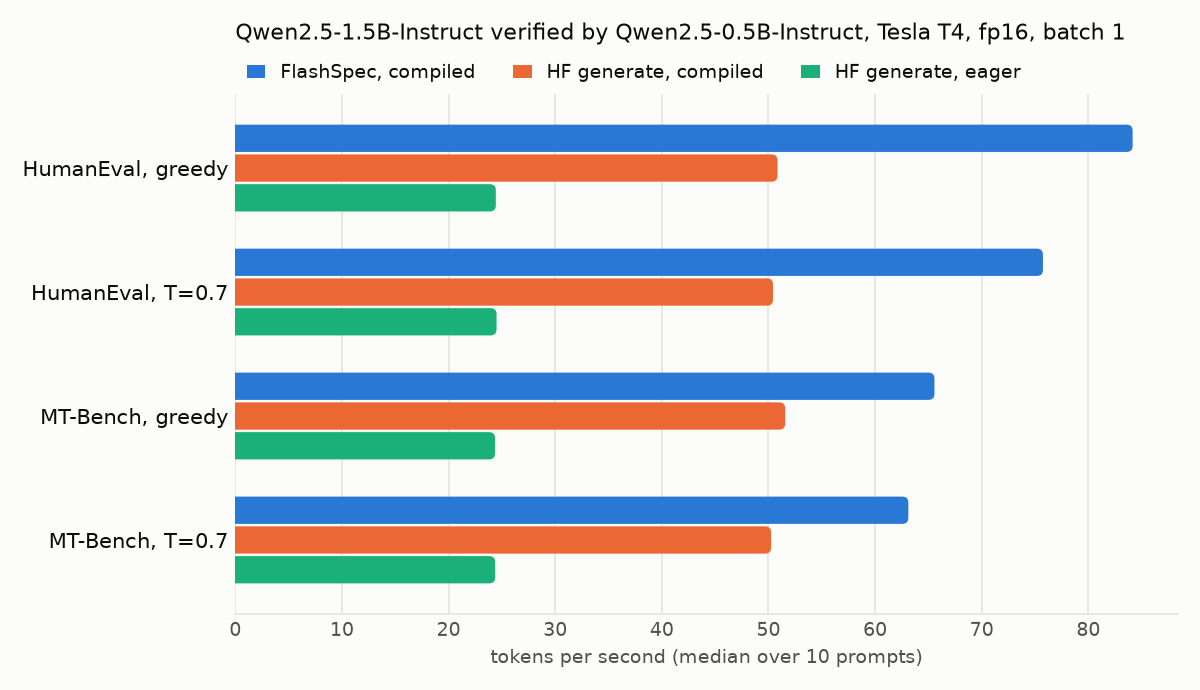
The chart is drawn from the same JSON field as the table by scripts/readme_chart.py; it adds no number of its own.
The full per-method table for the same run (eager FlashSpec and every HuggingFace baseline):
GPU Tesla T4 · torch 2.11.0+cu130 · drafter strategy composite-g6-f2 (prompt lookup up to 6 tokens when the context has a match, else the model drafter drafts 2; requested auto) · 20 result files · git 3c43e08. Prompts: chat_template; n per row: 10. Cells are the stored JSON values, not rounded.
| dataset | mode | method | tok/s median | tok/s p25 | tok/s p75 | acceptance | tokens / target fwd | target fwd / token | speedup vs plain HF (median) | speedup vs compiled plain HF (median) | speedup vs hf_assisted (median) | c (step profile) | greedy match | NaN/inf logits | peak GB |
|---|---|---|---|---|---|---|---|---|---|---|---|---|---|---|---|
| humaneval | greedy | flashspec_ucb | 35.695688670935155 | 29.562405679239028 | 38.56945102463008 | 0.3909112890710105 | 2.471042471042471 | 0.4125 | 1.451343369376347 | 0.7066183063738005 | 1.5587746305864147 | 0.8669655800732762 | 10/10 | 0 | 3.9214916229248047 |
| humaneval | greedy | flashspec_compiled | 84.15121158912345 | 72.74887834456933 | 89.15351141840875 | 0.3919555827630965 | 2.4758220502901356 | 0.41171875 | 3.4316137147436416 | 1.6703915213699534 | 3.6799192622210697 | 0.5669970109881699 | 10/10 | n/a | 3.935239791870117 |
| humaneval | greedy | hf_greedy | 24.429024644223723 | 24.328362833297252 | 24.54774113031622 | n/a | 1.0078740157480315 | 1.0 | n/a | n/a | n/a | n/a | n/a | 0 | 3.9279322624206543 |
| humaneval | greedy | hf_greedy_compiled | 50.84919550812026 | 50.817140359183256 | 51.01212214615007 | n/a | 1.0078740157480315 | 1.0 | n/a | n/a | n/a | n/a | 9/10 | n/a | 3.9221267700195312 |
| humaneval | greedy | hf_assisted | 23.302891492129334 | 21.183524392621223 | 24.424857044996198 | n/a | 7.231638418079096 | 0.14609375 | n/a | n/a | n/a | n/a | 10/10 | 0 | 4.010546684265137 |
| humaneval | T=0.7 | flashspec_ucb | 28.096687974443004 | 25.489319336463833 | 37.08217864854619 | 0.3852359399073896 | 2.397003745318352 | 0.425 | 1.1429797583795867 | 0.5554736867969583 | 1.5315892372032842 | 0.8643673380226606 | n/a | 0 | 3.942927360534668 |
| humaneval | T=0.7 | flashspec_compiled | 75.73985864164916 | 66.31949556957646 | 86.96726957235924 | 0.3852643082609558 | 2.401500938086304 | 0.42421875 | 3.066243803639478 | 1.5026896386679338 | 3.9158860079861073 | 0.5533693858522074 | n/a | n/a | 3.943270206451416 |
| humaneval | T=0.7 | hf_sample | 24.497491036510233 | 24.352074445631605 | 24.59023809444537 | n/a | 1.0078740157480315 | 1.0 | n/a | n/a | n/a | n/a | n/a | 0 | 3.9425158500671387 |
| humaneval | T=0.7 | hf_sample_compiled | 50.42612714053795 | 50.38888740804433 | 50.596619340479606 | n/a | 1.0078740157480315 | 1.0 | n/a | n/a | n/a | n/a | n/a | n/a | 3.9360790252685547 |
| humaneval | T=0.7 | hf_assisted | 18.844078044479534 | 18.04090535750411 | 21.24417385471367 | n/a | 6.037735849056604 | 0.1734375 | n/a | n/a | n/a | n/a | n/a | 0 | 4.024676322937012 |
| mt_bench | greedy | flashspec_ucb | 24.83938465726492 | 22.961833475251858 | 27.021801893823184 | 0.2620603532680512 | 1.9968798751950079 | 0.50859375 | 1.0179685727219971 | 0.4828425422653919 | 1.5451784248202172 | 0.8613753375863016 | 9/10 | 0 | 3.9019665718078613 |
| mt_bench | greedy | flashspec_compiled | 65.5665446517103 | 59.93265391596037 | 71.89633242799991 | 0.2868673245081164 | 2.022116903633491 | 0.50234375 | 2.6870360558531057 | 1.2745206859837361 | 3.9853712833572263 | 0.5318390145420024 | 8/10 | n/a | 3.9116411209106445 |
| mt_bench | greedy | hf_greedy | 24.358718936743088 | 24.18066265396688 | 24.491882521750334 | n/a | 1.0078740157480315 | 1.0 | n/a | n/a | n/a | n/a | n/a | 0 | 3.9123830795288086 |
| mt_bench | greedy | hf_greedy_compiled | 51.56689852526201 | 51.44110439771817 | 51.6446975154745 | n/a | 1.0078740157480315 | 1.0 | n/a | n/a | n/a | n/a | 10/10 | n/a | 3.9070162773132324 |
| mt_bench | greedy | hf_assisted | 18.834736736908617 | 14.102116189597641 | 20.858267222930852 | n/a | 3.8905775075987843 | 0.26484375 | n/a | n/a | n/a | n/a | 10/10 | 0 | 3.982469081878662 |
| mt_bench | T=0.7 | flashspec_ucb | 25.26133407738635 | 23.020854972868243 | 28.43236543070436 | 0.2884380538950996 | 2.0611916264090175 | 0.49296875 | 1.0434498871962403 | 0.5027379844644687 | 1.784691816669535 | 0.8687020810505087 | n/a | 0 | 3.9193735122680664 |
| mt_bench | T=0.7 | flashspec_compiled | 63.11715269934044 | 59.5644483083085 | 69.07556580010277 | 0.30095750082855754 | 2.071197411003236 | 0.490625 | 2.5801491971418065 | 1.2630258753083248 | 4.474878921310762 | 0.5388284128435155 | n/a | n/a | 3.9206857681274414 |
| mt_bench | T=0.7 | hf_sample | 24.371632087092596 | 24.137529875735552 | 24.643657960930078 | n/a | 1.0078740157480315 | 1.0 | n/a | n/a | n/a | n/a | n/a | 0 | 3.9260549545288086 |
| mt_bench | T=0.7 | hf_sample_compiled | 50.24734945285092 | 50.13961412887575 | 50.398525858279534 | n/a | 1.0078740157480315 | 1.0 | n/a | n/a | n/a | n/a | n/a | n/a | 3.9206881523132324 |
| mt_bench | T=0.7 | hf_assisted | 14.341218875882541 | 9.085275562353358 | 18.19088437853941 | n/a | 3.9751552795031055 | 0.259375 | n/a | n/a | n/a | n/a | n/a | 0 | 4.005721092224121 |
- forward_cost (humaneval): c eager 0.8987917949296391, c compiled 0.48198575930759086
- forward_cost (humaneval): c eager 0.9153857271517092, c compiled 0.47814633355546243
- forward_cost (mt_bench): c eager 0.9028193999622582, c compiled 0.4786350054126751
- forward_cost (mt_bench): c eager 0.9178312220110205, c compiled 0.4804902594066257
Speedups are medians of per-prompt ratios against the method in the same run. NaN/inf counts come from one untimed probe generation per method on the first prompt.
Provenance, the earlier bundles, the older 0.1.5 runs, kernel microbenchmarks and how a run is recorded are in docs/benchmarks.md. Every number above is a stored JSON value under benchmarks/results/gpu/3c43e08. The 0.2.0 tables (model drafter, bundle 8d036d7) are kept in the same folder layout.
Each batch-1 step does four things:
- The drafter proposes gamma tokens, with gamma forwards on its own KV cache (a lookup drafter runs no model).
- The target runs one forward over the pending token and the gamma drafts.
- The accept/reject test runs on the device: Algorithm 1 rejection sampling at temperature > 0, or the longest prefix that matches the target's argmax at temperature 0.
- One device-to-host read returns the accept count and the next token, and both caches are cropped by bookkeeping, with no extra forward.
With compile on, both models run on static KV caches and the fixed-shape decode and verify calls replay as CUDA graphs. Diagrams, batching and the proof sketch: docs/architecture.md.
- Sampling is lossless. Rejection sampling follows Algorithm 1 of Leviathan et al. (2023): a draft token
xis kept with probabilitymin(1, p(x)/q(x)), and a rejection samples frommax(0, p - q), normalised. The output then follows your model's distribution for any drafter. CI checks this with chi-squared tests on discrete tokens: test_output_distribution.py for model drafters and test_output_distribution_ngram.py for prompt lookup, which also shows that the checks fail on deliberately wrong residuals. - Greedy equals HuggingFace. At temperature 0 the output is
model.generate(do_sample=False)token for token. CI checks it in float32 on CPU (test_greedy_gold.py). - The fp16 caveat. On a GPU in fp16, kernels of different shapes can round an exact tie between the top two tokens differently, so greedy output can differ from HuggingFace at such a tie. A T4 diagnostic found every path token-exact in fp32, and every fp16 divergence at an exact top-2 tie on one side (diagnostic JSON). Every greedy GPU result reports how many prompts matched. In the 0.3.0 release run the divergences behind 9/10 (HumanEval) and 8/10 (MT-Bench) are those same three ties: both sides' outputs are token-for-token those of the tie-checked comparison run (bundle
fdd3be9). variant="typical"is lossy."rejection"and"greedy"are the lossless variants.
FlashSpec is alpha, version 0.3.1.
- Measured scope. One model pair (
Qwen/Qwen2.5-1.5B-Instructverified byQwen/Qwen2.5-0.5B-Instruct), one Tesla T4, fp16, batch 1, 10 MT-Bench and 10 HumanEval prompts, run frommainat git3c43e08with the defaultscompile="auto"anddrafter_strategy="auto"(which rancomposite-g6-f2). No other GPU, model pair or batch size has been measured. Every H100 number in the docs is a design target. - The first call compiles. On CUDA the first
generatecompiles the forwards and captures CUDA graphs, which can take minutes; later calls reuse them. The tables exclude that call. - Batch > 1 uses the generic loop: each step forwards only the largest group of rows that share a context length.
- Single device. One process and one GPU or CPU. The server has no streaming, no paged KV cache and no continuous batching.
- Windows and macOS.
pip install flashspecworks, but Triton is Linux-only, so the compiled path is Linux + CUDA only. - Default drafter strategy.
"auto", which runscomposite-g6-f2with one model drafter at batch 1. Passdrafter_strategy="bandit"for the 0.2.0 behaviour. - Experimental: the bandit. The UCB1/Thompson selector was measured choosing among seven arms once (Phase 6, bundle
3e38251) and did not beat the best fixed arm on the mixed workload. See docs/bandit.md and the CHANGELOG. - Experimental: the kernels. The Triton
verify_tokens/gather_acceptedkernels and the assembly residual are not called on the generation path; the accept/reject test runs in PyTorch. Measurements: docs/kernels.md. - Waiting on a GPU or an upload: docs/postponed.md.
Not scheduled and not implemented:
- A contextual bandit, run once. The Phase 6 bandit had no context, and the best fixed arm changed between consecutive prompts of the mixed workload more often than not. A pre-registered design: the context is the next lookup's match length bucket ({0, 1-2, 3-4, >= 5}), which the step's single device read already carries; with no match the arms are Qwen at gamma 2, 4 and 6, otherwise n-gram and Qwen at gamma 2, 4 and 6; the value per (context, arm) is total emitted tokens / total seconds, not a mean of per-step ratios; UCB1, normalised, verify width 7. Its exit criteria would be fixed before the run (beat
composite-g4and every fixed arm on the mixed workload in both modes, within 5% of each set's best fixed arm, faster than compiled HuggingFace everywhere, no new greedy mismatches), and a miss would be recorded without tuning or a second attempt. The oracle ceiling estimated from the Phase 6 bundle is small, so near parity with the composite strategy is the expected outcome. - A larger target (Qwen2.5-3B-Instruct with the 0.5B drafter on the T4), the batch > 1 path, and draft log-probs kept in the model dtype.
@misc{myet2026flashspec,
  title = {{FlashSpec}: Adaptive Speculative Decoding with Online Bandit
             Draft Selection and {Triton}-Optimised Verification},
  author = {Myet, Min Htet},
  year = {2026},
  month = jun,
  howpublished = {Zenodo preprint},
  doi = {10.5281/zenodo.20766119},
  url = {https://doi.org/10.5281/zenodo.20766119},
}
Preprint DOI: 10.5281/zenodo.20766119 (June 2026). That record is the citable archive. paper/flashspec.tex is a later draft (October 2026, software 0.2.0) and has not been deposited. Machine-readable metadata is in CITATION.cff.
See CONTRIBUTING.md. make test runs the unit and integration suites on CPU, with no GPU needed. Test commands, the repository layout and links to the papers and notebooks are in docs/development.md. Changes are listed in the CHANGELOG. An index for AI agents is in llms.txt.
Apache 2.0. See LICENSE.